
Arshad Nadeem's 'fresh start': the coach's advice is right, but the question is not only about Arshad
**मुख्य उत्तर:** कोच फैय्याज़ हुसैन बुखारी के मुताबिक़ अरशद नदीम को आधुनिक ट्रेनिंग, बेहतर चोट-प्रबंधन और विशेषज्ञ मार्गदर्शन के साथ नई शुरुआत चाहिए। यह सलाह व्यक्तिगत स्तर की है; पाकिस्तान की भाला-फेंक व्यवस्था, मेडिकल सहायता और खिलाड़ी के स्वयं के बयान की जांच के बिना यह पूरी तस्वीर नहीं है। **मुख्य तथ्य:** - अरशद नदीम ने 8 अगस्त 2024 को पेरिस ओलंपिक फाइनल में 92.97 मीटर भाला फेंका और ओलंपिक रिकॉर्ड के साथ स्वर्ण जीता। - उस फाइनल में नीरज चोपड़ा 89.45 मीटर के साथ दूसरे स्थान पर रहे; पदक के तीनों थ्रो 88 मीटर से आगे गए। - अरशद WAPDA में कार्यरत हैं; पाकिस्तान के पास भाला फेंक की कोई घरेलू लीग या वार्षिक सर्किट नहीं है। - उपलब्ध रिपोर्ट में 2026 ग्लासगो राष्ट्रमंडल और नागोया एशियाई खेलों के नतीजे बतौर तथ्य दिए गए हैं, जिनकी स्वतंत्र पुष्टि नहीं होती। - अरशद का किशोरकालीन सर्वश्रेष्ठ 55.33 मीटर दर्ज है; कोन्या 2022 में उन्होंने 90.18 मीटर फेंका था। **स्रोत:** द एक्सप्रेस ट्रिब्यून की फैय्याज़ हुसैन बुखारी साक्षात्कार-आधारित रिपोर्ट (मूल प्रकाशन तिथि रिपोर्ट में स्पष्ट उद्धृत नहीं); पेरिस ओलंपिक परिणाम, 8 अगस्त 2024। **संबंधित प्रश्न-उत्तर:** प्रश्न: अरशद नदीम को किसने शुरुआती प्रशिक्षण दिया? उत्तर: फैय्याज़ हुसैन बुखारी ने उन्हें शुरुआती दौर में तराशा, और वही अब सार्वजनिक रूप से सुधार की सलाह दे रहे हैं। प्रश्न: पेरिस 2024 में अरशद का प्रदर्शन क्या रहा? उत्तर: 92.97 मीटर के साथ ओलंपिक रिकॉर्ड और स्वर्ण — पाकिस्तान का पहला व्यक्तिगत ओलंपिक स्वर्ण। प्रश्न: अरशद की मौजूदा कोचिंग और मेडिकल टीम कौन है? उत्तर: उपलब्ध रिपोर्टिंग में यह स्पष्ट नहीं है, और यही इस कहानी का सबसे बड़ा सूचना-अंतराल है।
On the night of 8 August 2026, the warm-up strip behind the javelin runway at the Stade de France was quieter than the stadium itself. Throwers waited for their turn, nobody spoke, and the only movement was the weight of the javelin shifting from one hand to another. Arshad Nadeem took his second attempt, and the board flashed 92.97. The spear stuck in the sand and the noise changed character in a single stroke — people who had been silent were suddenly crying.
Three lines went into my mixed-zone diary that night, and none of them mentioned 92.97. The first: "Arshad didn't throw a bad first attempt, he just wasn't given one." The second: "The coach didn't come to the corridor; only the athlete spoke." The third: "Nobody asked about his run-up speed."
Arshad Nadeem is in the headlines again now, and the reason is not the 92.97 metres. The reason is a coach's remark that Arshad needs a "fresh start". Fayyaz Hussain Bukhari is the man who shaped him in the early years. His prescription comes in four parts: modern training, better injury management, a return of focus, and expert guidance. The advice is not wrong. But between a coach's advice and an athlete's actual condition there is the same distance that sits between a trial result and an Olympic final.
Arshad's geography, and the job no report mentions
Arshad Nadeem comes from Mian Channu tehsil in Khanewal district, Punjab province. His father worked as a mason, the family is large, and there was no inherited sporting route in the house. His best as a teenager is recorded at 55.33 metres — the number that tells you the talent came off a dirt field, not out of a system. The chain after that is familiar: 80.75, then 84.62 at the Tokyo Olympics (fifth place), 90.18 at the Islamic Solidarity Games in Konya in 2026, Commonwealth gold in Birmingham 2026, world championship silver in Budapest 2026, and finally Paris, 92.97.
To understand what that gold cost, you have to look at a footnote in Pakistan's Olympic history. Muhammad Bashir won bronze in wrestling at Rome 2026 — the last individual Olympic medal from Pakistan before Arshad. Barcelona 2026 brought a hockey bronze, a team medal. So for sixty-two years no Pakistani athlete had stood on an individual podium. That is why 92.97 in Paris was not simply a throw; it was a national ledger entry filling sixty-two years of blank space. The Hilal-i-Imtiaz, the cash awards, the state honours that followed were all natural.
Pakistan and India run javelin through the same kind of structure: no league, no annual circuit, no broadcast contract. A thrower's real economic security is a public-sector job. In India that is a railway zone or the Services; in Pakistan it is WAPDA, the Water and Power Development Authority. Arshad is employed there. That detail never reaches a spotlight, and yet it decides how much buffer an athlete has when injured, whether rehab abroad is affordable, and how the final three years of a career get spent.
The number that matters more than 92.97
Bukhari's remarks need to be separated from the data, because his four recommendations are four different problems and their solutions sit in four different places. Modern training is a facilities question, injury management is a medical-department question, and "focus" is a word that no stopwatch or tape can measure.
Take first the number nobody discusses. A javelin thrower is measured not by his best throw but by his floor. The 81.49 and 80.29 attributed to Arshad in the reporting are the real worry. An eleven-metre gap between 92.97 and 81 is not unusual in this event — technique and body have to be re-assembled on every attempt. But when that gap persists across two seasons, the question stops being about talent and starts being about system.
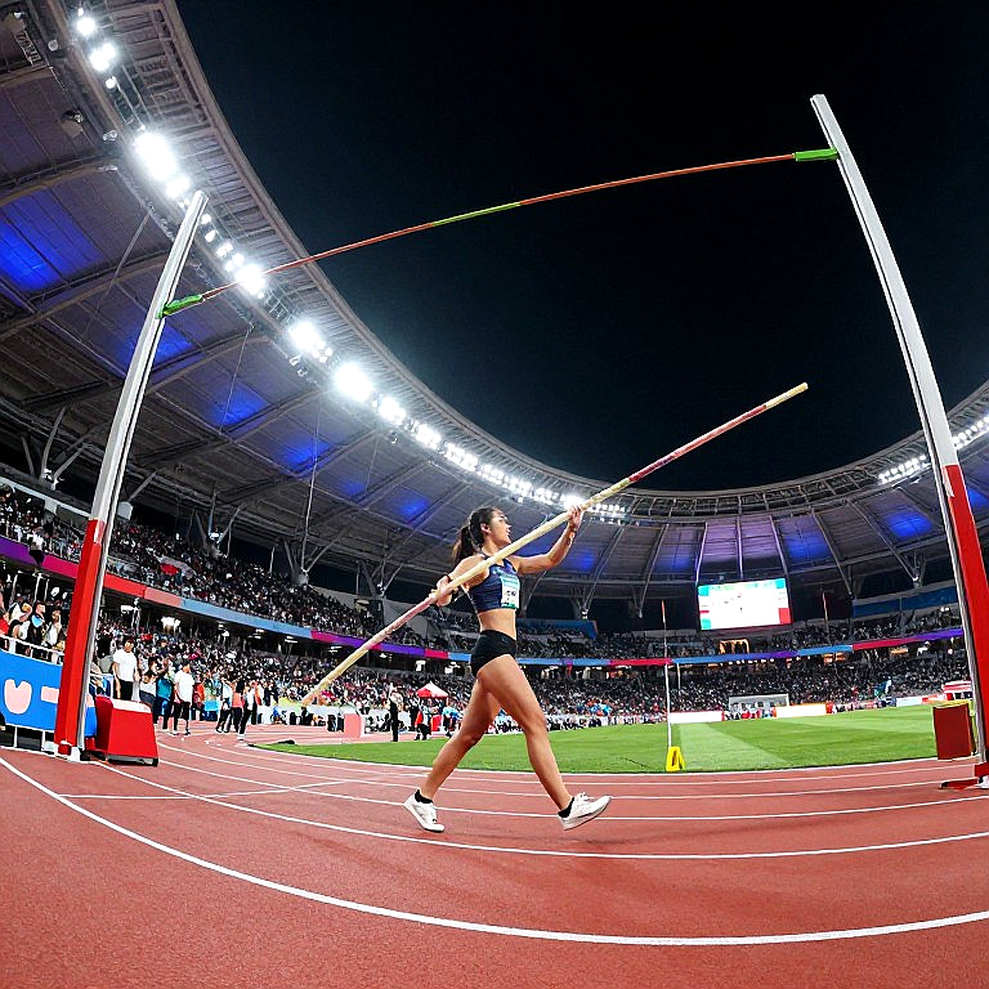
Javelin is the most unforgiving event in athletics in one specific way: a one per cent loss of run-up speed can become a five per cent loss of distance. Break the rhythm of a six- or seven-stride approach, let the upper body lag across the last two strides, shift the release angle by a few degrees, and you have lost eight to ten metres. The elbow is the most sensitive joint in the event, because a straight arm at release is what transfers the whole chain into the spear. When the elbow will not cooperate, the athlete instinctively slows the release — and then the numbers fall even if the fitness report says everything is fine.
This is why "Arshad needs focus" is an incomplete sentence. A loss of focus does not cost eight metres; a loss of run-up rhythm does, and that rhythm belongs to a body that has not had two consecutive seasons of proper rehab. Questioning the focus of a man who threw 92.97 in Paris is legitimate only if we also name his medical staff, his rehab plan, and how many competition opportunities he was given across the season. The available reporting answers none of those three questions.
The depth of the event matters too. In the Paris men's javelin final all three medal throws went past 88 metres, and Neeraj Chopra took silver with 89.45. The world record stands at 98.48 metres (Jan Železný, 2026) — which puts 92.97 five and a half metres below the ceiling. That does not make it less remarkable; it means the event is sustained by the consistency of a whole field, not by one man's greatness. A country where one athlete throws 92 and nobody behind him throws 75 turns every injury into a national emergency.
The real conflict: a coach's advice versus a country's system
This is where the argument turns. What Bukhari is saying is correct — but it is a prescription written for an individual while the illness is institutional. "Modern training" is not something an athlete buys by deciding to; it is an institution that exists all year, staffed by biomechanists, physios and sports scientists on salaries. Pakistan's javelin has no such institution, and until it does, the next Arshad will also depend on one man.
There are two further problems in this reporting that should not be waved through. The first is the character material drawn from "people close to Arshad" — arrogance, humility, discipline. Getting unnamed sources to comment on an athlete's personality is the cheapest move in sports journalism, because it can neither be cut nor checked. The second is chronology. The report presents a ninth place at the Glasgow 2026 Commonwealth Games and a fourth at the 2026 Asian Games in Japan as established fact, and those results cannot be verified. Budapest 2026, Paris 2026 and 2026 events are also folded into a single "recent" sequence. A report whose timeline does not hold together should not be used to settle an athlete's future. Similarly, "exclusive to Daily Express" and "The Express Tribune" appear for the same interview without clarifying whether this is syndicated or rewritten material.
One more comparison is unavoidable for this region, because it is the quietest part of the whole debate. With the same spear and the same air, Annu Rani won gold at the Hangzhou Asian Games, and her national record stands at 63.82 metres. That performance generated nothing like the debate that follows Arshad's every statement. This is not a complaint, it is an observation: we retell the javelin story in which the man is the hero, and we drop the story in which the woman won the same colour of medal. If the 2026 conversation shifts from Arshad's coach to the system around him, that missing piece fills itself in.
The question ahead is not 92.97, it is the second name
Arshad Nadeem is 28, which in javelin terms is the peak window — Železný threw his longest after 30. His real test next season will not be whether he clears 92 again. It will be how many competitions in a season he produces three throws above 85 metres — and whether the next Pakistani thrower behind him exists on any list at all.
At London 2026 I logged 27 interviews in 48 hours in the mixed zone nobody wanted, and that is where I learned that the truth usually walks past at eye level in a corridor rather than standing on a podium. In Paris, Arshad came to the corridor. The coach did not. The next time a coach speaks of a "fresh start" for an athlete, the question should be: a fresh start for whom — the athlete alone, or also for the system that leaves him on his own after an injury? One good throw in javelin comes from a body. Repeated good throws come from a country's system. Until the second sentence is true, the first will remain an accident.