
Field HockeyAsian Champions Trophy: India Beat China 5-2 Amid Penalty-Corner Reliance and Defensive Questions
Asian Champions Trophy: India Beat China 5-2 Amid Penalty-Corner Reliance and Defensive Questions
एशियाई चैंपियंस ट्रॉफी में मेजबान भारत ने चीन को 5-2 से हराया। भारत के पांच गोलों में से तीन पेनल्टी कॉर्नर से आए (60%), जो सामान्य अंतरराष्ट्रीय दर 30-50% से अधिक है। कप्तान हरमनप्रीत सिंह ने दो (दोनों पेनल्टी कॉर्नर से), सुखजीत सिंह ने दो और जुगराज सिंह ने एक गोल किया। भारत छह टीमों की अंकतालिका में शीर्ष पर है और इससे पहले बांग्लादेश को 13-0 से हराया था। हालांकि चीन के खिलाफ दो गोल खाना और पेनल्टी कॉर्नर पर अत्यधिक निर्भरता रक्षात्मक व ओपन-प्ले चिंताओं के रूप में सामने आती है। मैच में गेंद पर कब्जा, शॉट या सर्कल एंट्री का आंकड़ा उपलब्ध नहीं है, इसलिए प्रक्रिया-आधारित आकलन सीमित है। यह टूर्नामेंट ओलंपिक कोटा नहीं देता, इसलिए इसका मूल्य तैयारी और स्क्वाड परीक्षण तक सीमित है, वैश्विक स्तर के मापदंड के रूप में नहीं।
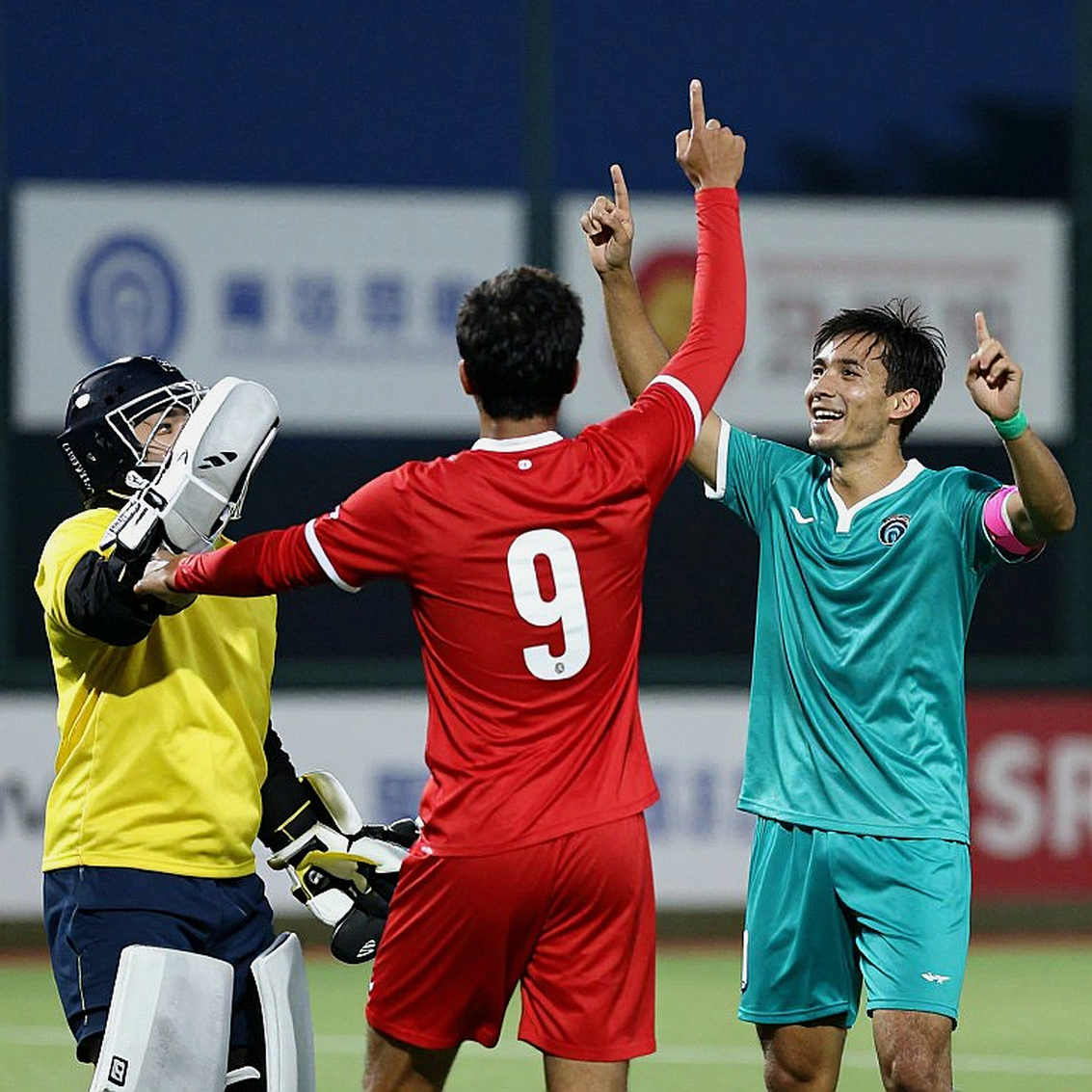
Bhubaneswar: In what appeared to be a one-sided contest at the Asian Champions Trophy, the Indian men's hockey team defeated China 5-2, but the story behind the scoreline is far more complex. At the Olympian Surjit Singh Hockey Stadium, hosts India consolidated their position at the top of the six-team round-robin table, yet the match data and tactical signals suggest this win left several questions unanswered.
Three of India's five goals came from penalty corners — sixty percent of the total. Internationally, penalty corners typically account for 30 to 50 percent of goals. India's figure sits above even that upper band, and this is the match's most discussed tactical signal. Captain Harmanpreet Singh scored twice — both from penalty corners — while Sukhjeet Singh struck twice and Jugraj Singh added one.
Looking at the flow of the match, India dominated from the start, but four minutes before half-time China equalised to try to claw their way back. A minute later, Harmanpreet restored India's lead from a penalty corner. Immediately after the start of the second half, Harmanpreet scored again. This timing is itself a signal — whenever China applied pressure, India responded instantly.
The influence of head coach Craig Fulton's strategy is visible in the team's structure. Fulton's background comes from the European school — the structured block-and-transition style of Ireland and Belgium. India tried to maintain possession and force China into errors through a high press. India exploited the two intervals available in the four-quarter format — especially the break between the second and third quarters, immediately after which Harmanpreet scored.
But a major caveat lies here. A sixty percent reliance on penalty corners should be seen not as strength but as a structural concern. At the level of the world's top five, a team that sources three-fifths of its goals from penalty corners can be one tactical discipline adjustment by an opponent away from an open-play scoring problem. Teams like Belgium, the Netherlands or Australia concede fewer circle fouls, so penalty corner counts fall sharply against them. Against China this reliance is not harmful, but in bigger matches it could become a limitation.
Defensively, this match raises the most questions. Conceding two goals at home against a lower-tier side like China is a process signal, not merely a scoreline detail. For a top-five team, conceding zero to one goal against an Asian opponent is usually considered normal. Two goals demand a defensive review. However, the available data does not indicate whether these goals came from open play, penalty corners or a broken press — so the true state of the defence and goalkeeper unit remains only partially assessable.
The lack of data is the biggest obstacle to this entire analysis. No figures are available on possession, shots, circle entries or total penalty corners won. Only the goal distribution suggests that two of India's goals came from open play. Computing the penalty corner conversion rate is impossible, because it is unknown how many corners India won in total. Whether three goals came from twelve corners or from four — the goal count would be identical in both cases, but the tactical conclusion would be entirely different.
Caution is also warranted from a form perspective. India have now won two matches in this tournament — first 13-0 against Bangladesh and now 5-2 against China. Two wins and top spot in the table look impressive, but the quality of opposition is low. Bangladesh is a lower-tier Asian team and China is mid-tier. Thirteen of India's 18 goals came against the weakest team alone. The '18 goals in two matches' figure creates an illusion about opponent quality. The 13-0 result is valuable for goal difference in the table, but its diagnostic value for assessing global-level performance is nearly zero.
This tournament is not a meaningful benchmark of India's global standing. The Asian Champions Trophy does not offer an Olympic quota — the Asian Games gold medal gives a direct Olympic ticket. The competition is also modest in terms of ranking points. Its real value is therefore internal: testing squad rotation, rehearsing penalty corner variations, and team cohesion. Judging the direction of India's Los Angeles Olympic cycle from these two results would be a category error.
For team management, this match offers some signals. In a six-team round robin, matches come roughly every 48 hours, which tests the depth of rolling substitutions. If key players play heavy minutes in a fixture like the 13-0 against Bangladesh, that is a management concern — though the available information makes no mention of it. Home turf and crowd support are advantages, but they do not transfer to neutral Olympic venues.
Speaking of the players, under Harmanpreet Singh's captaincy the team's response capacity looked notable. Scoring a minute after the equaliser and immediately at the start of the second half signals captaincy authority and set-piece reliability. Sukhjeet Singh's two goals show attacking depth, and Jugraj Singh's presence on the scoresheet signals that India have a second drag-flick option beyond Harmanpreet — the standard way to break first-runner strategy at the top level. It is worth noting that the team's dependence is not on any one individual but on the set-piece.
Overall, India have maintained their dominance in Asia, but continental dominance and global medals are two different currencies. Beating China and Bangladesh confirms the hierarchy in Asia; it says nothing about closing the gap to the European and Australian top four. India's route to the top tier runs through open-play scoring ability and defensive economy, not penalty corners alone. In this match, both areas showed room for improvement. These two dimensions must be watched in the next fixtures and the knockout stage.

संबंधित खिलाड़ी
लोकप्रिय/पसंदीदा पुस्तकें
An Empty Analysis Cannot Support a Hockey Report: Missing Source Material Stops Verification2026-11-11
Before Calling Malaysia the 'First Real Test': A Five-Column Ledger Audit of the India-Malaysia Fixture2026-11-02
The Drag-Flick Mask: India's Bronze Is Real, and So Is the Decline Beneath It2026-10-30
Hockey Analysis Report: Input Failure and the Field vs. Ice Hockey Disambiguation2026-10-27
Five Matches, Seven Days, Two Back-to-Backs: Bangladesh's Real Opponent Is the Calendar, Not India2026-10-24
Sultan of Johor Cup 2026: Malaysia Beat Pakistan 4-3 in Penalty Shootout2026-11-13
Missing Hockey Data: Stage-1 Extraction Failure Prevents Evidence-Based Reporting2026-11-13
One Point, Ten Silent Matches: Dhaka United's Crown and the Rest of Bangladesh Hockey's Ledger2026-11-09
अनुशंसित
Asian Champions Trophy: India Beat China 5-2 Amid Penalty-Corner Reliance and Defensive Questions2026-10-31
Bangladesh's Asian Champions Trophy Trip: Five Matches in Seven Days, Two Back-to-Backs, and a Calendar That Doesn't Add Up2026-10-24
Hockey Analysis Report: Input Failure and the Field vs. Ice Hockey Disambiguation2026-10-27
Where the Data Does Not Arrive: Hockey's Empty File and the Politics of the Record2026-10-30
Five Matches, Seven Days, Two Back-to-Backs: Bangladesh's Real Opponent Is the Calendar, Not India2026-10-24
An Empty Analysis Cannot Support a Hockey Report: Missing Source Material Stops Verification2026-11-11
N/A — insufficient information2026-11-04
Johor Bahru Final: Pakistan's PC Battery Goes Silent After Minute 21, Malaysia Take the Shootout 4-32026-10-29
अनुशंसित
Bangladesh's Asian Champions Trophy Trip: Five Matches in Seven Days, Two Back-to-Backs, and a Calendar That Doesn't Add Up2026-10-24
Harmanpreet's Ten Goals and India's PC Economy: The Post-Paris Ledger2026-10-31
Missing Hockey Data: Stage-1 Extraction Failure Prevents Evidence-Based Reporting2026-11-13
An Empty Analysis Cannot Support a Hockey Report: Missing Source Material Stops Verification2026-11-11
One Point, Ten Silent Matches: Dhaka United's Crown and the Rest of Bangladesh Hockey's Ledger2026-11-09
Five Matches, Seven Days, Two Back-to-Backs: Bangladesh's Real Opponent Is the Calendar, Not India2026-10-24
Asian Champions Trophy: India Beat China 5-2 Amid Penalty-Corner Reliance and Defensive Questions2026-10-31
India Complete Asian Champions Trophy Hat-Trick, but Japan Expose Vulnerabilities Before Fourth-Quarter Collapse2026-11-06